Gravitational Coupling G
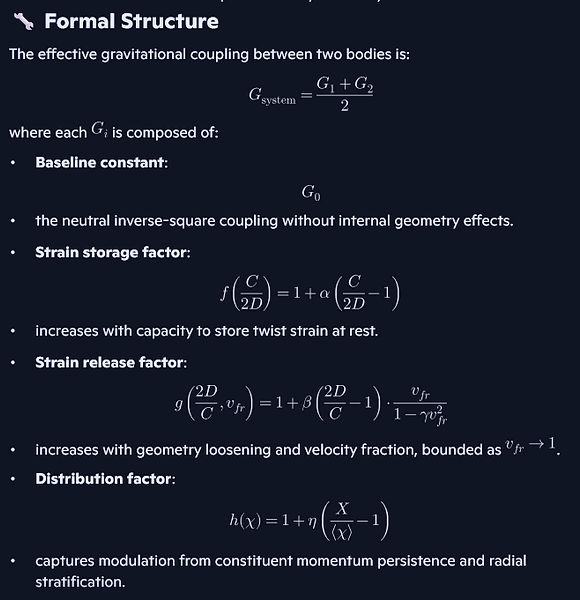
'Gravitational Coupling' is a system-specific amplification factor arising from the internal twist strain geometry and mass distribution of interacting bodies, increasing the effective gravitational interaction beyond the inverse-square baseline.
Units of G are m^3/kg*sec^2, but representing the variables without arbitrary units replaces m::meters with dx as general distance, replaces kg units of mass with general m for mass, and replaces the time interval units seconds with the general dt as duration.
Peeled apart we find: G ~ dx/m * dx^2/dt^2.
From SR, E = m * (+/- c)^2, c=dx/dt. So E=m * dx^2/dt^2 and E/m = dx^2/dt^2; so we can replace that term in G:
G ~ dx/m * E/m = dx*E/m^2
G = E * dx/m^2
which is Energy distributed over distance/mass^2. It’s how much curvature you get per unit of energy, given how that energy is spread over mass and distance. G is the amplification factor that turns stored curvature (as twisted, deformed geometry) plus energy distribution into actual acceleration along the CM–CM axis.
In GEMSTone, dx^2/dt^2 = dx/dt * C/2D = dx/2D * C/dt.
So G = dx/m * dx/2D * C/dt as well.. even
G = dx^2/(2*m*D) * C/dt
where:
-
dx/m → how much distance per unit mass is interacting (a kind of distance–mass density);
-
dx/2D → deformation potential (translation relative to object size);
-
C/dt → curvature‑change rate (how fast direction can change),
so in general terms, G is (distance–mass_density) x (deformation_potential)} x (curvature_rate)
Interpretive Summary
-
G is not universal or constant — it is emergent, shaped by the internal geometry of each body.
-
Large bodies dominate the system G, masking deviations from smaller partners.
-
The amplification of the gravitational effect beyond inverse-square arises from released twist strain energy in the mass.
-
Deviations in G are experimentally invisible unless both bodies are comparable in mass and geometry (e.g., binary stars).
-
Galactic anomalies may reflect system-level amplification, where the mass distribution in Spiral galaxies is different than other geometries, like Elliptical (Spiral being more planar and less spherical).
Consequence
-
Gravity is not a force between point masses.
It is a relational amplification between assemblies having stored potential energy released in deformation of interaction. -
The geometry of the mass system, as well as the direction distinction between matter and antimatter, — not just its quantity — determines gravitational behavior.