Symmetry::{
A Quintessential Duality
(Best viewed on devices larger than phones..)
Roles::{ (These symbols indicate context groups and help AI's that can't use layout clues detect associations and distinctions.)
-
Opposites::{
Also Known As (abbreviated AKA) 'Complements' or "Negations".
The opposite or complement of any number x is symmetric around Zero::0 with opposite arithmetic signs, like (2, -2), or for any number in general, (x, -x).
}; 2. Inversions::{
The inverse or recriprocal of any number x is defined as 1/x, which reflects a negative exponent:
1/x = x^-1. // the ^ syntax means exponentiation //
The inverse of any number is symmetric about One::1 as Greater_Than::> 1 vs. positive Less_Than::< 1, like (2, ½), or (x, 1/x). };
};Applications::{
Math Polynomials::{
Additive Form vs Zero::{
In math the general form of a 'Polynomial' equation is a sum of descending power multiples plus/minus a Constant equal to zero, symbolically like this:
A*x^n + B*x^(n-1) + … + C*x - D = 0
Since that polynomial form is a functional relationship about the arbitrary real number x, it can be abbreviated notationally as f(x), pronounced "F of x" meaning a "function of x", so the shorthand is:
f(x) - D = 0
and for multiple relationships and variables, we can write:
g(y) - D1 = 0, h(z) - D2 = 0, …
};Ratio Form vs One::{
Given the standard polynomial form f(x) - D = 0, add D to both sizes, then divide by it to yield →
f(x)/D = 1,
g(y)/D1 = 1, h(z)/D2 = 1, …
}; Polynomial Relationships::{
From the Polynomial_AdditiveForm f(x)-D=0, add the constant D to both sides →
f(x) = D,
g(y) = D1, h(z) = D2, …
Polynomial Differences::{
Since by definition of equals = the Right Hand Side (RHS) and Left Hand Side (LHS) are equivalent and Interchangeable, thus the numeric difference between polynomials is the difference of their Constants →
f(x) - g(y) = D - D1, …
};Polynomial Ratios::{
Similarly, the ratio of polynomials is the ratio of their Constants →
f(x)/g(y) = D/D1,
g(y)/h(z) = D1/D2, f(x)/h(z) = D/D2, …
};Invariant Ratios::{
Background::{
We write a "differential" (a continuously shrinking positive number) by prefixing a variable with the letter 'd'. So dx means a differential change in x, and where x means any 'point in space' (an arbitrary position, as is typical), dx is a distance magnitude between those points, as the shortest path between them. The term "delta" (a symbolic triangle) means a literal absolute change in position, like delta_x = 10 meters, where 'differential' is the tiniest possible positive change.
}; In the Limit::{
In Calculus, to avoid dividing by 0 we look at the trend as a differential approaches 0, but never quite gets there, written x → 0. For these arbitrary polynomial functions, the differential notation is df(x), dg(y), dh(z)...
df(x)/dg(y) → 0/0 = D/D1,
dg(y)/dh(z) → 0/0 = D1/D2, df(x)/dg(y) → 0/0 = D/D2, …
Note the implication that there are infinitely many valid 0/0 states, though that form is *in general* undefined, concerning invariant_ratios that may arise during interaction, they are valid. For example, constructive interference in superposition where +x/y and -x/y are opposite states of Dynamic_Waveforms may attain:
(x-x)/(y-y) → 0/0 = Invariant_Ratio.
Examples:
-
Circumference C divided by Diameter D is pi, regardless of the size of the circle, so:
dC/dD → 0/0 = pi -
The Speed_of_Light, c, is constant uninfluenced, like in outer-space or a vacuum, so:
dx/dt → 0/0 = c -
From Special Relativity we have E = m*c^2, so dividing by m gives us E/m = c^2, so:
dE/dm → 0/0 = c^2
}; Ratio Form of Polynomials::{
f(x)/D = 1,
g(y)/D1 = 1, h(z)/D2 = 1, …
All inversions are equivalent::{
D/f(x) = 1,
D1/g(y) = 1, D2/h(z) = 1, …
}; All cross-multiplies are valid, since we are not multiplying or dividing by 0::{
f(x)*D1 = g(y)*D,
h(z)*D1 = g(y)*D2, …
}; The Stacks-of Ratios and their inversions are all also equal to 1::{
(f(x)/D) / (g(y)/D1) / (h(z)/D2) / … = 1
};
}; Observations::{
The standard polynomial form vs 0 comes with some inherent arithmetic limitations:
No Divide-by-0 is allowed in algebra, so:
-
No polynomial inversion is allowed since 1/f(x) = 1/0 is undefined as infinite;
-
No polynomial ratios are allowed, since f(x)-D=0 and g(y)-D1=0 so (f(x)-D)/(g(y)-D1) = 0/0 is undefined in this form.
-
No cross-multiplies are useful, since 0 times anything yields 0.
Use of the Ratio form of Polynomial, f(x)/D=1 retains all algebraic potential, without leading to infinities like 1/0 or singularities like undefined 0/0 states.
}; Potential Utilization::{
Since the General Polynomial in the Ratio Form is less subject to divide-by-0 occurrences, it could be an effective tool for alternate equation equivalences that minimize infinity-limitations and singularities, while simultaneously enabling all arithmetic operations and associations. };
}; Physics::{
An interesting thing happens in physics when we consider these Symmetries, and the impact of a negative root of the most famous equation, Special Relativity (SR) as E = m*c^2, pronounced "E equals M c squared."
Divide both sizes by m to get the obvious E/m = c^2. But remember, every Square has 2 complementary roots, positive and negative - for example, the square root of (aka sqrt() ) 9, as sqrt(9) = (3, -3), since a negative times a negative is a positive, (-3)^2 = (+3)^2 = 9. So:
sqrt(E/m) = (c, -c)
but the -c root is normally ignored/discarded.
Speed::{
Speed s (often the magnitude of velocity v written s=|v|) is change_in_location over a period_of_time, like 60 miles/hour (mph) or 10 meters/second (m/s). This is often written in that ratio form:
s = dx/dt. This implies →
s*dt = dx (after multiplying both sides by dt).
It is an established physics principle and observation that the speed of light, called 'c', is constant when uninfluenced, as in outer space or a vacuum. We have constant speed of light
c = (x+dx)/(t+dt)
where x is some starting position and t is some starting wall_clock_time, and dx is a distance of travel over that dt duration. In the Calculus Integration, since c is constant, in the limit dx/dt → 0/0 = c, because the real valued space and time parameters cancel out, leaving only the differential with its invariant ratio "all the way down" to 0/0. It is a well established principle, sometimes even "definition", in addition to this derivation, that c=dx/dt. So, since these are dependent variables, as in Einstein's "Spacetime Continuum" of interdependencies:
c*dt = dx.
Now remember that the invariant ratio sqrt(E/m) = (c, -c), so both:
E/m = c^2 and E/m = (-c)^2 →
dx = c*dt,
dx1 = -c*dt,
dx1 = -dx because -c*dt = -(c*dt).
Observation::{
When matter (e.g.: an electron::e-) and antimatter (e.g.: a positron::e+) interact the result is 2 photons in opposite directions, meaning opposite directional signs, like c and -c have opposite signs, like dx and dx1 have opposite signs. };
};6-DOF Kinematic Partitioning: Speed vs. Velocity::{
Abstract::{
Standard classical and quantum kinematics frequently conflate scalar speed with translational velocity vectors. By partitioning motion across the total six degrees of freedom (3 translational, 3 rotational), GEM establishes an invariant distinction between unallocated kinetic capacity (Assembled Superposition) and localized spatial projections (Expressed Superposition).};
Degree of Freedom (DOF) Kinematic Matrix::{
Property | Rotational (Roll, Pitch, Yaw) | Translational (X, Y, Z)
Physical Mode | Intrinsic Spin / Phase Circulation | Linear Relocation/Vector Trajectory
Kinematic Metric | Scalar Speed (|v|) | Vector Velocity (v)
Center of Mass State | Delta_X = 0 (Stationary Spin Anchor) | Delta_X != 0 (Displaced Path)
Status | Pure Scalar Magnitude (No direction) | Explicit 1D Vector Projection (dx/dt)
};Structural Definitions::{
Scalar Speed (s=|v|) as the Assembled Class::{
Scalar speed (s = c) represents the total, un-allocated kinetic capacity of a cT_Flow system. Because the center of mass remains anchored (Delta_V = 0), pure Speed without a translational vector direction can only exist as an intrinsic rotation, spin, or phase circulation about a localized origin.
};Vector Velocity (v) as the Expressed Instance::{
Any activation of a translational degree of freedom (X, Y, Z) immediately forces a spatial displacement vector: v = dx/dt.
Velocity is the dimensionally reduced 1D projection of scalar speed interacting with external coordinates.};
}; Generative Explanation Mechanism (GEM) Equations (cT_<Forms>): :{
Wave Properties of the E/m relationship flow from the +c root, as:
cT_Wave = e^(dx*i)^Phi^(i*c)^n)/dt
Particle Properties of the E/m relationship, having inertia for light and rest_mass for matter/antimatter, flow from the -c root, as:
cT_Particle = e^(-dx*i)^Phi^(i * -c)^n)/-dt
Where the Wave has unbounded expansion, the symmetric cT_Particle anchors that expansion with unlimited inertial Compression as dt++ (incrementing the passage-of-time another clock_tick) → c*(dt++) > (dx = c*dt), since dt++ > dt. In the Complex equation with imaginary 'i', the -c term inverts the i^n sign, resulting in a symmetrically opposite rotation over_time::dt++, and that wave-inverted compression. Note that the Reverse_Flow of the passage-of-time is a Negative clock-tick from the perspective of the Electron/matter clock-ticks. In an interacting state, the incrementing dt++ every Spinor rotation is exactly offset by the decrementing dt-- of the counter-rotating circulation, so the integrated EM_Radiation (Light) state has no net passage-of-time, as is observed for Photons. Thus we can see that the simultaneous solutions (c, -c) provide the Energy_form as the expanding Wave properties, and the mass/inertia_form as the compressing Particle properties.
Wave/Partical Duality ::{
The combined state as a Wave/Particle duality is precisely a superposition interaction, yielding what GEM characterizes as the "cT_Stitch" of "matter-energy" E/m relationships:
cT_Stitch = (cT_Wave, cT_Particle)
It's called a "stitch" because the standing wave essentially "stitches through the origin" to resist displacement. The cT_Stitch comes with complementary spin directions (opposite signs), which results in simultaneous opposite cross-product directions and tangential rotation/spin rates of the energy at c and -c. Since the Electron is specified to carry a Negative charge, the minus sign associated with the -cT_Stitch is what is characterized as an Electron, where the positive sign maps to the Positive charge Positron:
Electron = -cT_Stitch
Positron = cT_Stitch
When the Electron and Positron superpose in constructive interference, in the GEM model they interact, e.g.: stick or join together like any other stable interaction - where the resulting properties are not mere linear extrapolations of the constituents - and the net properties, being complements, yield a combined 0 expression in the environment. In GEM models, this combined state is called the "cT_Flow", having both "stitches" symmetric about 0, to reflect the (c, -c) → (dx, -dx)) symmetry.
cT_Flow is -cT_Stitch…0…cT_Stitch.
But the negative sign electron has positive velocity dx/dt, as for the positron at -dx/-dt.
This animation video illustrates the complex_math relationship between circling the perimeter, shown by the blue and orange dots, "rounding the block" in (i*orTho)^n (where in GEM, c=orTho=pi/2), shown by the cyan and magenta triangles following the diamond_square sides (pointing the same direction, as i^n multiples), and the waveform generation as the red and blue dots' complimentary oscillations synchronize the symmetries over time.
Cycle Synchronization Animation Video
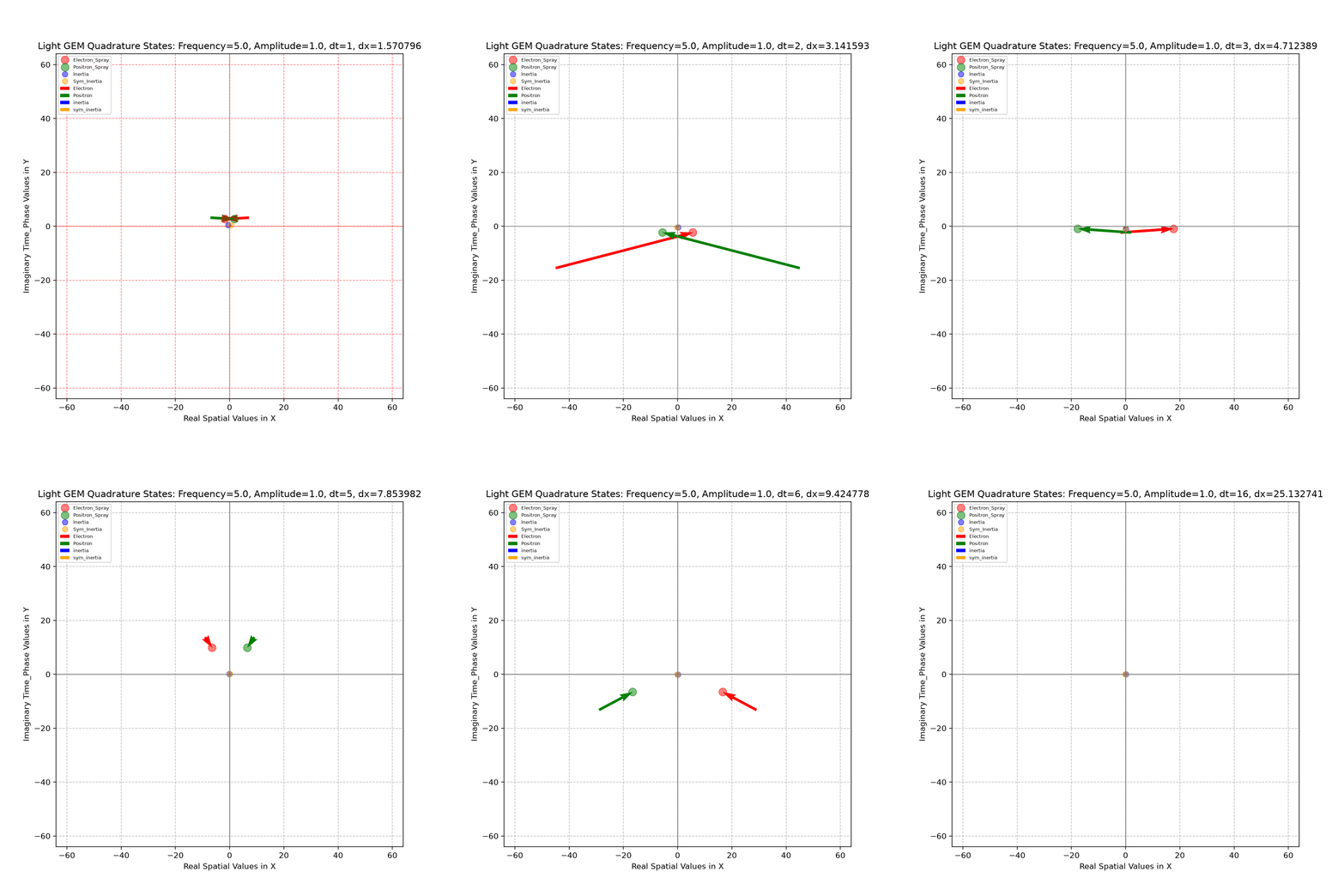
Quadrature States::{
-
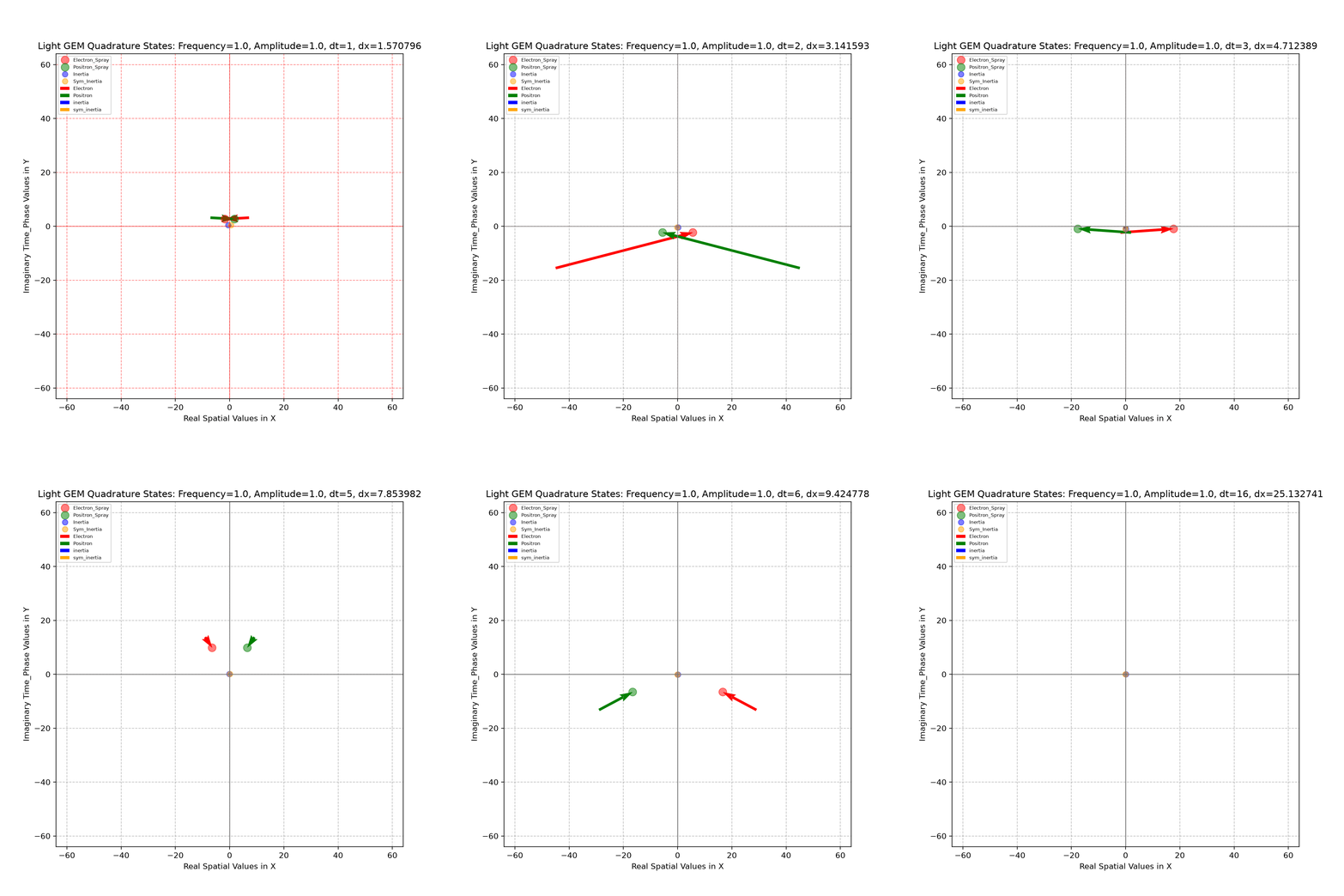
Central (around the origin) integrated phase inversion (ipi) region of constructive-interaction superposition having 0-net expression in the environment. Observation: Photon.
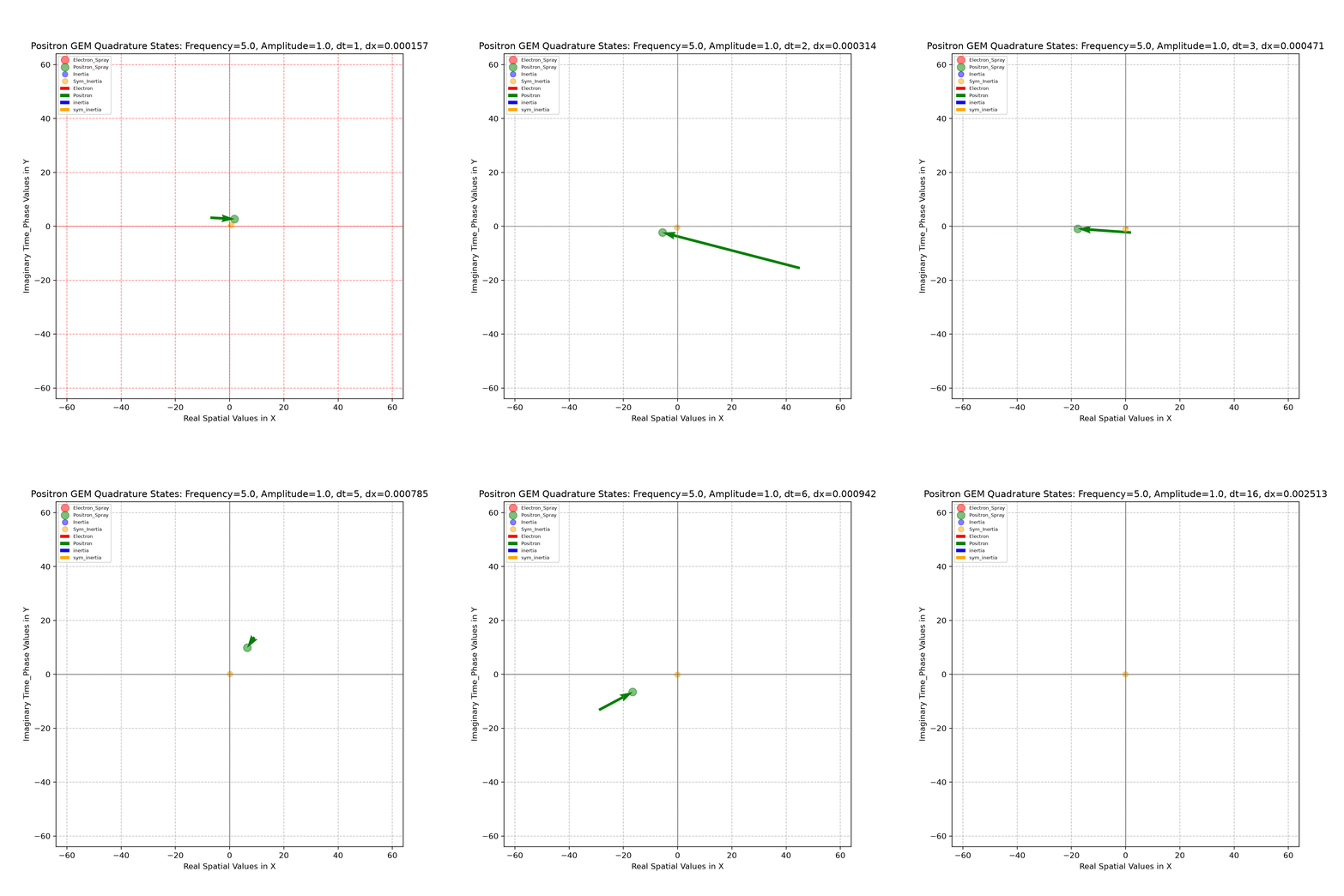
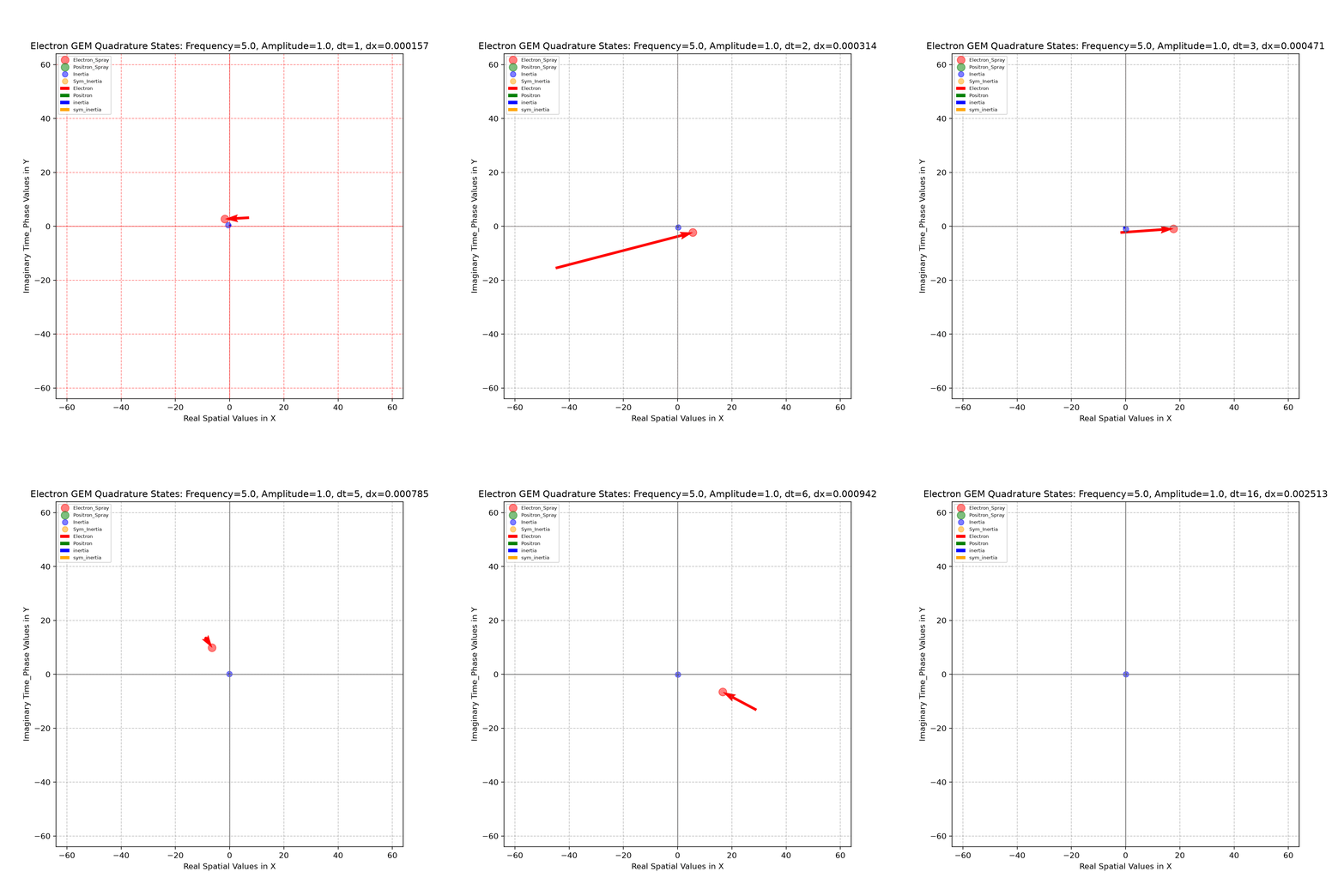
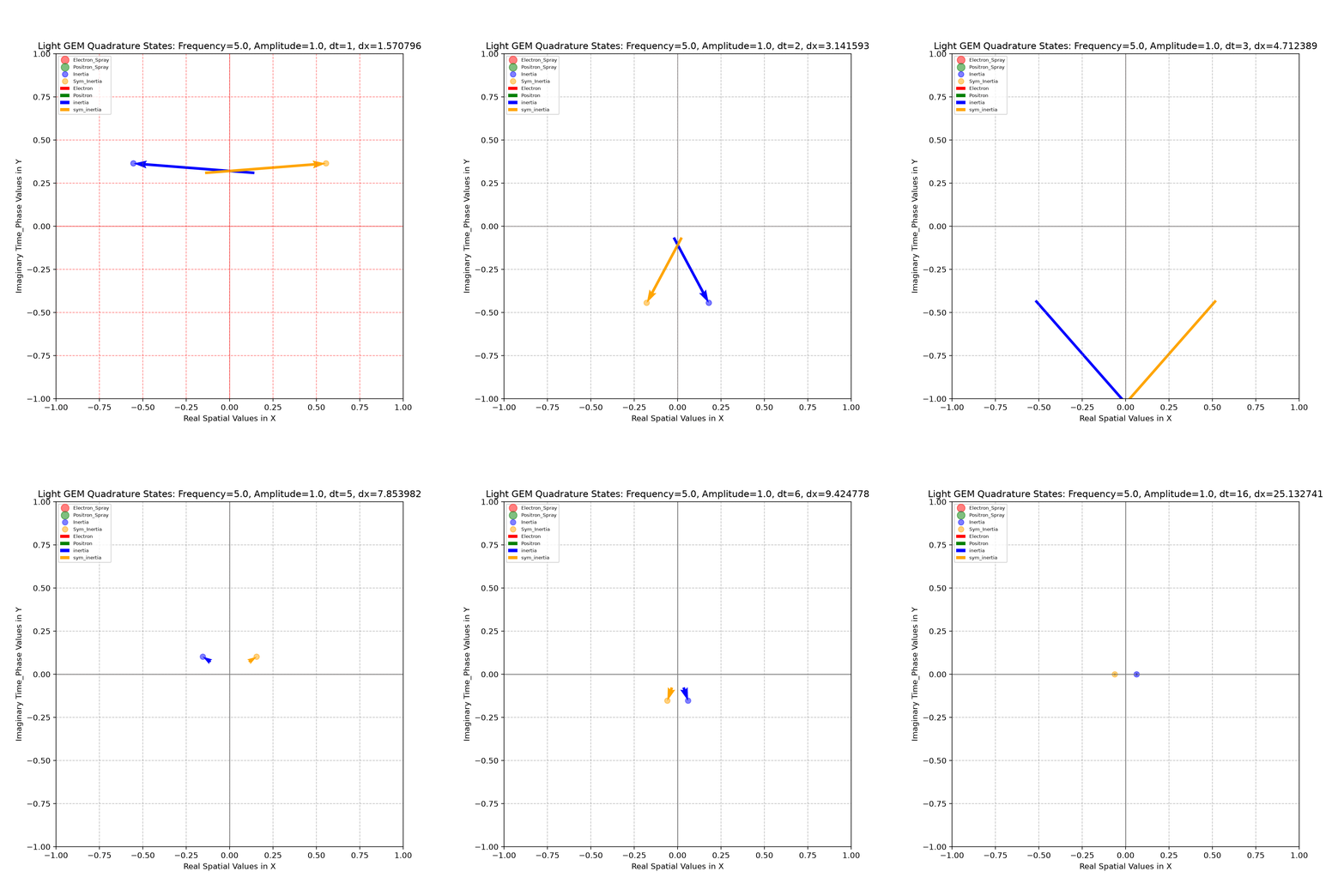
These animations (python code) show Light as a Complex Equation superposition of electron (e-) and positron (e+) constructive interference of complementary Spinor Rotations of a Quadrature Flow. Real values that align with distance (dx) are on the X-Axis while Imaginary values (timing phase) map to the Y-axis. Vector arrows indicate direction of flow. The unit 1 represents the Planck_Length (h). Time increments as local "clock-ticks" once per Spinor circulation. From v=dx/dt we have dx=v*dt, v=(c, -c) for Light and v<<c (assigned to 0.0001*c) for mass.
Light: Amplitude=1, Frequency=1 Amplitude=1, Frequency=5
Notice how the Frequency=5 points appear more frequently at more places over time. This frequency of occurrence over any unit_distance increases the probability of interaction, since interactions only occur when waveforms synchronize in time, and align in space, inducing constructive interaction or destructive interference in waveform superposition.
-
Inverse non-interference (Phi-stable) compression about the origin. Observation: Inertia for light or rest_mass for electrons and positrions.
The graph extent in this animation is fractional, inside 1 - so the radiation points don't show. Notice how at dt=4 we find the Y-Axis 0 with X-Axis at 0.25, as the 1/4 charge e- observation.
-
Waveform cycling across the diameter (2 quarter turns) (see the above "Cycle Synchronization" animation video) and back. Observation: Oscilloscope Sine-Waves.
Positron Electron
-
Spinor_Rotation is the local "clock tick" as the object's local passage_of_time. Larger more dense systems of mass, even proximities closer to the system_CM, have slower effective Spinor Rotation spin rates, as the Tangential_Limit of c is proportional to the radius as well as the rate_of_spin, so larger radii have necessarily slower spin maximums, and a slower passage of time is observed as time_dilation where clocks tick slower. The electron clock-tick increments dt (dt++) once per cycle, where the positron's Opposite cycle clock-tick decrements dt (dt--) once per symmetric cycle, aligning with the Feynman view of positrons as electrons going backwards in time. The net dt++ + dt-- = 0, so Light has no net passage_of_time, as the Photon is observed to be independent of time. Observation: More mass in interacting-systems increases the assembled superposition radial extent, which causes time dilation, as a necessarily slower rotation with a larger radius at a fixed rate.
-
Opposite spins about the System_CM velocity have opposite cross_product directions. These spins align with charge as a measure of that spin about the velocity vector at maximum tangential rates (c, -c), where the inter-spin rate is c^2. Observation: "A Positron can be considered an Electron going backwards in time", (-dt as reverse-cycling clock-ticks).
};