Lorentz Transform Factor (LTF)
The Lorentz Transform Factor (LTF) is found in the GEM cT_geometry as:
Where:
nu := arctan(|v|/c)
omega := arctan(|v|)
|v|/c = cot(nu)
|v| = cot(omega)
LTF = 1/cos(nu) = sec(nu)
LTF Length Contraction and Time Dilation
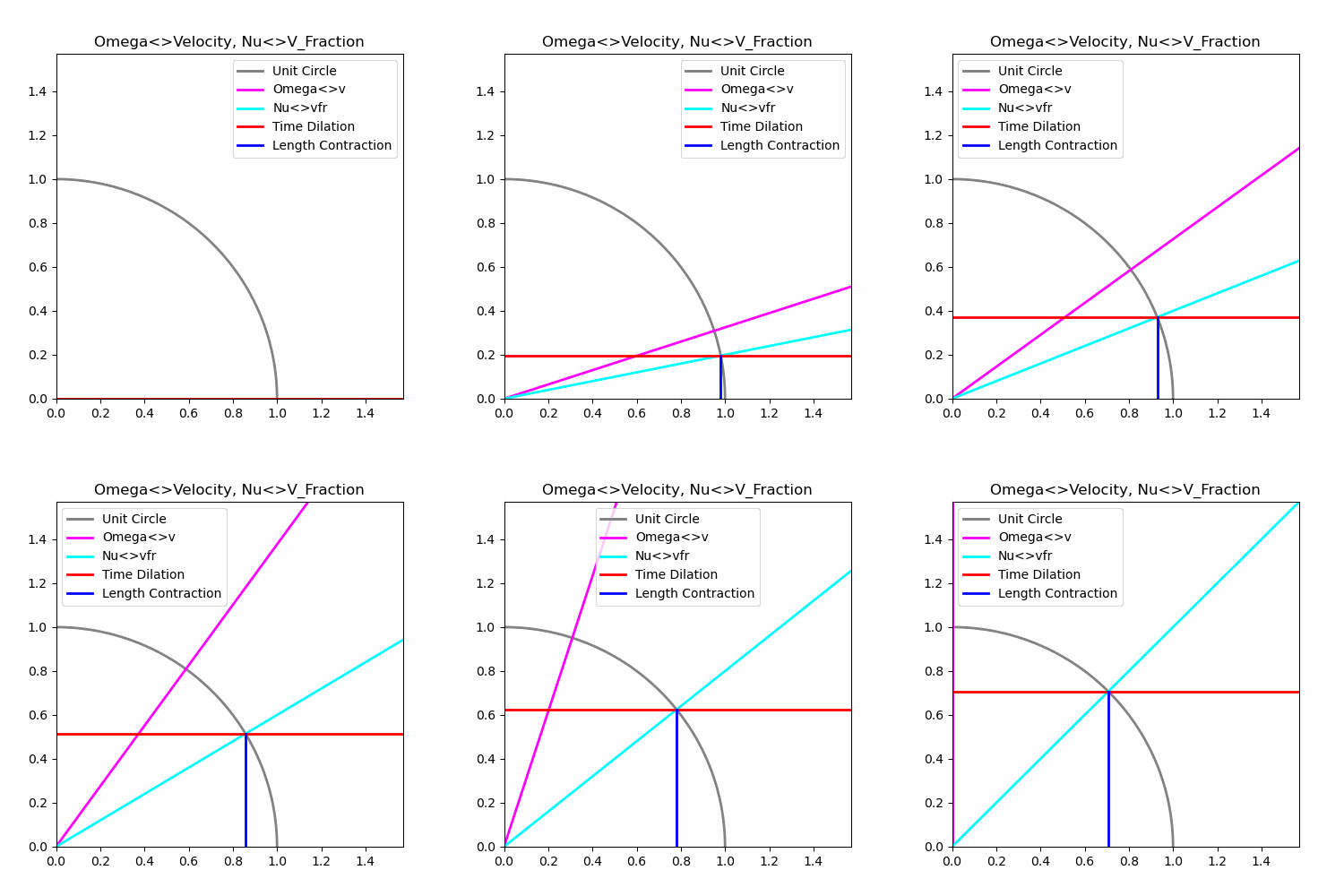
This animation shows the omega and nu angles as they rotate with speed, as under acceleration,
-
from speed |v|=0 as horizontal, to |v|=c at maximum slope vertical at 90 degrees, called orTho, at pi/2 radians, and
-
from speed fraction of light_speed, |v|/c = 0 horizontally to |v|/c = 1 at 45 degrees, orTho/2 as pi/4 radians.
The radial length is the raw speed value as given by cot(omega), and the radial speed_fraction length is cot(nu). The length term dx is cos(nu) and length contraction is shown on the X-axis over the range of speed_fraction angle nu, which shows the maximum LTF is sqrt(1/2) at pi/4 radians when |v|=c and c/c and c^2/c^2 = 1. Similarly the duration dt shows time dilation on the Y-axis as sin(nu), where cos(nu)/sin(nu) = cot(nu) = |v|/c as the speed_fraction, which also has a maximum value of sqrt(1/2).
Observation
The normal LTF term is written as v^2/c^2, but notice the equivalence to (v/c)^2, which is a speed_fraction relationship, not a raw speed relationship. The speed_fraction is bounded at pi/4 radians, which is finite, where the raw speed projection from pi/2 radians grows unbounded, leading to potential momentum of an electron exceeding that of an entire galaxy, as |v| approaches c!
Normalization
The unit circle shown in the animation represents the normalization path of dx and dt under acceleration in cT_geometry, preserving the invariant ratio definition of speed |v|=dx/dt. As speed increases, both spatial and temporal components rotate along the circle, maintaining the invariant relationship.
Mass and Momentum
Note that from momentum p=m*v, we can express speed as:
|v| = p/m
This behaves identically mathematically/geometrically to:
|v| = dx/dt.
In GEM cT_geometry:
-
Momentum p lies on the X-axis and contracts under acceleration;
-
Mass m lies on the Y-axis and increases under acceleration, it doesn't remain fixed at "rest mass" when Energy is added to the system.
This reflects the reality that added energy increases mass, per E=m*(+/- c)^2.
It is invalid to treat mass as constant under acceleration, because doing so:
-
violates the invariant ratio E/m=(+/-c)^2;
-
breaks the definition of momentum as p = m*v; and
-
misrepresents the structural transformation of the system under acceleration from added Force (where F=m*a).
Delta V: Acceleration vs. Frame Shift
It is essential to distinguish between two types of velocity change:
1. Delta_V from Acceleration
-
Adds energy to the structure;
-
Alters intrinsic properties (mass, momentum, passage_of_time, geometry);
-
Causes real deformation and twist strain;
-
Changes the internal state of the assembled structure.
2. Delta_V from Relative Frame Rates
-
Does not add energy;
-
Does not alter intrinsic properties;
-
Merely accounts for observational distortion between frames;
-
Arises from the constancy of the speed of light.