

Energy Filament Model
Energy as Electromagnetic (EM) Radiation (aka Light in all its frequencies, including visible colors, radio waves, microwaves, x-rays, and the rest) propagates in 3D space over time at the speed of light, called 'c', which is constant uninfluenced (as in a complete vacuum or outer space). Spins in 3D space project onto 2D planes, like graph paper and oscilloscopes, as an oscillation (see the picture above).
Rotational Symmetry of Rate
The GEMSTone model of Energy adds a symmetry not found in traditional physics - rotation at rate c as the limit achieved by Light as the translation limit achieved by Light is also c.
Complex Equation of Light
This 2D graph shows the general form of the complex equation of GEMLight for EM radiation where the gold curve is the Imaginary number part (using i = sqrt(-1)) and the blue curve is the Real number part. The imaginary part represents the time-phase aspect of light while the real part represents the spatial component of light. These curves dissipate with distance or time, since c=dx/dt means either distance dx or time dt can use used since they are fixed multiples of each other, as c*dt = dx, and dt = dx/c, per the inverse square relationship observed for EM radiation.
In 'cRadians', the maximum slope models the maximum spin in the X-Y plane, so c = pi/2 Radians (thus the name, cRadians).
Spin Model
As was mentioned, these 2D plots are projections of a 3D spin onto a flat plane. These pi-spaced oscillations in 2D represent 3D spins in space. What is Frequency in an oscillation interpretation is the number of central axis crossing per unit distance. As the Frequency increases, the curves pack more tightly together. In the GEMSTone model, the distance between the real and imaginary curves relates to the wavelength of the energy as a spinning filament with the general form as shown by the curve - so as the Frequency increases, the wavelength as distance-between-curves decreases, and this is visualized as the energy filament getting narrower. A higher oscillatory Frequency is a more tightly wrapped 3D spin of thinner filament width which more completely fills the volume of space in which the energy filament spins - this equivalent to more dense matter more completely filling its volume.
Cross Products and Gyroscopic Stability
Notice that these curves are projections of spin about the Y-axis which represents Time (dt), where the X axis represents Distance (dx). Since speed s = dx/dt, when s = c, dx/dt = pi/2 Radians. A spin at rate c does 2 things simultaneously: First, it induces gyroscopic stability about the central axis, in this case stability about the Time vector as the vertical Y-axis; second it causes some spatial indeterminism since the spin about Time occurs in space. This accounts for observations of non-locality such as quantum tunneling.
The GEMSTone model of matter/antimatter interaction, as electron and positrons in this context, follows the Law of Assembly: The waveform of the electron and the waveform of the positron under coherent alignment engage in constructive superposition. The Feynman view of a positron being treated as an electron going backwards in time is maintained in the GEMSTone model. The mechanism in GEMSTone is the opposite cross-products of the opposite spin directions of the electron and positron at c about the Time axis. The cross product of the electron spin at c points 'forward' in our view of the passage of time, while the cross product of the positron at spin -c points 'backward' in our view of the passage of time. The spin differential between them is |c*-c| = c*c = c^2 (meaning c-squared).
The photon is the region of constructive interference over an electron/positron wavelength, which results in these velocities (+dx/+dt) + (-dx/-dt) producing dx/dt → 0/0 = c. This is seen as the relatively "flat" spot around the origin in the curves. As soon as that state is achieved, the invariant speed c is obtained by the superposed wavelength and the assembly as EM Radiation with electron-lobe and positron-lobe with Photon as the superposition propagates linearly at c.
The inverse square dispersion of the energy filament starts from its peak Amplitude of brightness, and diminishes from there. For scale, an Amplitude of 1 decreases to below the minimum ionization energy of an electron at about c meters (1 light second) from the origin. Energy and photons are not point size particles - they have extent as shown by the equations of the waveform. Objects do not interact at regions comparable to their size, ever. Note that Any two rigid spheres of Any size interact at exactly 1 point. Arbitrary curves in opposite directions interact at a singe point. A photon is the length of an electron/positron wavelength. The EM radiation is attached continuously to the photon region of the waveform and dissipates with distance according to its initial amplitude.
Net Spin Cancellation
Remember that in math, when the Left-Hand-Side (LHS) is equal to the Right-Hand-Side (RHS) of an equation, as in LHS = RHS, each side is equivalent to the other, by definition of equals (=). Where E=m*c^2, Energy exchange of 'E' terms is equivalent to m*c^2 interaction.
The opposite-spin electron and positron counteract each other's inertia, and the net inertia (mass) is 0 for Light. The time vectors are opposite and cancel leaving no stability about the Time axis. The negative electron charge as e- is opposite to the positive positron charge as e+ and these cancel leaving the Photon with 0 charge. Charge is a measure of spin about the Time vector axis.
The dual-spin system itself spins about the origin, and that cross product creates the direction of propagation of the photon, orthogonal to the electron and positron lobe propagation directions. These symmetric spins at the same rate propagate in 3D space, and the lobe extents form a spherical shell in space - and this is the source of the inverse square dispersion of Force over distance.
These plots of GEMLight show two complementary waveforms containing photons in superposition. The central photon regions are net-zero in amplitude and do not engage in constructive interference, since any waveform added to zero retains its original value. This structural non-interaction explains why multi-colored light — including white light — can be decomposed into its constituent photons: they coexist within the superposition without altering each other’s geometry. Each filament retains its twist density and frequency, allowing diffraction or filtering to reveal the individual components.
If the Light decouples its superposition interaction between the electron and positron, these opposite spins no long counterbalance, and the electron's spin at c give it stability in that orientation of Time while the positron's relative spin at -c give it stability in that opposite orientation of Time, and each inertia is present as the mass of matter (electrons) and antimatter (positrons).
Electron/Positron Dual-Lobe Geometry
Electrons and positrons are opposite-spin solutions of the same Real/Imaginary waveform equation. In photon superposition, their spins cancel, producing a massless propagating filament. Bound electron-lobes are anchored by their positron-lobe partners and remain fixed in atomic photon shells. Decoupled electron-lobes become free waveforms that synchronize at discrete points, creating the illusion of particle behavior.
GEMSTone Expansions
Since the conversion from the Energy state to the Mass state depends on the opposite spins whose spin differential is c^2, so the ratio for the GEMSTone expression is E/m = c^2 - or in the more familiar form, E = m*c^2. We know c=dx/dt, and in the GEMSTone Cradian measure c=pi/2, and pi = C/D. Thus all these forms are interchangeable, with s as an arbitrary speed:
E/m = s*s, s=c
E/m = (dx/dt)^2 = dx^2/dt^2, c=dx/dt
E/m = pi^2/4 = C^2/4*D^2, c=pi/2, pi=C/D
E/m = dx/dt * C/2*D
E/m = dx/2D * C/dt
This GEMSTone meme shows the invariant ratios, from left to right: C/D=pi, E/m=c*c, dx/dt=s.
Note that these invariant ratios produce invariant ratios, as (E/m) / (C/2*D) = dx/dt = c.
Balanced Form
E/m * (dt*4*r)/(dx*C) = 1
Note that c=dx/dt where dx/dt is a Differential of an invariant-ratio, so dx/dt-->0/0=c "all the way down". This couples dx and dt together by the frame-independent maximum speed, c. That mathematical coupling serves to Synchronize the 4*r with the C term, since their multipliers are coupled as an invariant-ratio. In Quantum Mechanics (QM) waveforms are often characterized by complex equations that use the imaginary-number 'i'. In GEM, orTho = pi/2 Radians and the fundamental form is (i*orTho)^n, which couples Turning Corners at right-angles via 'i' with going around a circle via the orTho/pi-based curvature Transcendental factors. Note that for n=2 we have (i*orTho)^n = i^2 * orTho = -1 * orTho^2. In GEM, c = orTho so the E/m relationship is -c*c as -c^2, not the positive-only c^2 as E=m*c^2. Mathematically, E/m = c^2 --> sqrt(E/m)=(c, -c), since both positive and negative roots exists for every square. Dropping the minus-sign prevents any return to an origin. Speed of Light c is explicitly Not velocity as speed@direction, as there is no direction-angle component of c. But, if there is a Speed without a net direction it must return to its origin to net 0 displacement, because Every non-zero displacement has a Direction. For example, an oscillation or circulation or pulse that returns to an initial position has no net direction so is pure speed, not velocity, but every linear displacement has a direction and is a velocity, not a speed. Dropping the negative root Prevents a return to origin which Induces a direction which turns a speed into a velocity, which is an error in Cardinality, not mere quantity. A speed like 10 mph could be in Any direction, so in 3D space you could go 10 mph N,S,E,W, up, down, or any combination. That's a 3D sphere and a 2D shell of potential locations after any fixed duration. However, without a "return potential" of -c, a displacement is Forced which results in a particular Direction Vector which is only 1D, and after any fixed duration resolves to one single point, not a 2D shell. Droppin the -c root is an error of 2 Dimensions of independent Cardinality as degrees-of-freedom.
This animation integrates and Energy Waveform Phasing as a horizontal oscillating point with a point travelling the perimeter of a unit-circle to illustrate the (4*r)/C relationship from SR. It also integrates the waveform phasing with the i*orTho component of QM as the Triangle travelling the diamond-square synchronized with the oscillating-dot and the circling-dot. Where all the symbols converge in the center is where waveforms can interact as particles. The internal-oscillation phasing has a resonant peak, and that is represented by the dot rotating around the circle - that's where a "particle" aspect exists, so the internal phasing has an associated circulation about the central axis. Electrons and positrons circle the time-vector, where quarks and antiquarks circle the spatial-directions +/-(x,y,z). Circling the time-vector occurs in spatial-dimensions as is the source of spatial indeterminacy for electrons/positrons. The Lorentz Transform Factor is the distance between the unit-circle and the diamond-square sides.
Rate‑of‑Curvature Limit
An algebraic reorganization of the GEMSTone expansion reveals these geometric relationships:
E/m = dx/2D * C/dt
We see a couple of things here: a maximum rate at which curvature can change, expressed as C/dt. This limit governs how fast a structure can change direction, independent of its translational speed. The effective turn‑rate of a system is the product of its curvature‑rate limit and its deformation‑susceptibility factor dx/2D, which scales with object size.
Consequences include:
-
Direction change is geometrically bounded.
-
Larger assemblies have slower turn‑rates.
-
Velocity and curvature are inseparable.
-
Acceleration is constrained by geometry, not force.
-
Spin, mass, and curvature share the same invariant.
-
Special Relativity’s speed limit is one half of a deeper dual limit:
-
max translation rate
-
max curvature‑change rate
Curvature capacity = (Influence potential) / (Deformation resistance)
For a given structure, the effective rate of direction change C/dt is the ratio of its influence potential E/m to its deformation potential dx/2*D. Stiffer, larger, or more rigid assemblies resist curvature and turn slowly; more deformable or articulated assemblies can redirect influence more rapidly.
Potential Energy
In the GEMSTone expansion E/m=C^2/4*D^2, an increase in Energy requires an increase in the geometric ratio on the right-hand side. For a fraction to grow, the numerator must increase faster than the denominator. Thus, increasing E corresponds to the Circumference term C growing more rapidly than the Diameter term D. Geometrically, this means the Filament’s overall twist length increases faster than its width, tightening the rotational strain. This twist tightening is the structural mechanism by which a Filament stores higher potential energy.
Subluminal Form
Objects with mass like electrons have speed s < c and appear as an angle between 0 and pi/2 radians.
GEMSTone Kinetic Energy
KE/m = s/2 x C/2*D
This expression arises from the mixed GEMSTone Energy form:
E/m = dx/dt x C/2*D with the substitutions:
-
c=dx/dt
-
c=pi/2 in Cradians
-
pi =C/D
The GEMSTone form reproduces the standard mechanical result, where 's' is speed without direction:
KE = 1/2 * m*s^2
but reveals why the one‑half factor appears.
The one-half term is applied to s because in cRadians, the speed angle is:
omega = arctan(s) // s is speed without direction
and the speed-fraction angle is:
nu = arctan(s/c) // Speed without direction fraction of max speed of light
so the maximum slope when speed s = c is pi/2 radians, while the maximum slope of speed fraction is s=c at c/c = 1 at pi/4 radians. Thus the speed‑fraction angle reaches only half the maximum slope of the raw-speed angle. This is the geometric origin of the familiar 1/2 factor in kinetic energy: the halving comes from the angular geometry of speed, not from the structure of space.
When Force is added to a structure with s<c it can manifest as speed increase or velocity change, geometric deformation, or a combination. In the limit, a rigid structure transfers all Force into increased speed as acceleration in a changing direction, while a sufficiently non-rigid structure transfers all Force into increased geometric distortion before the structural renormalization results in a velocity difference at the CM of the structure, where velocity is characterized for a massive object. When the geometry of the waveform twist loosens, the effect is increased speed and changing velocity.
Force, Rigidity, and Subluminal Response
When Force acts on a structure with speed s < c:
1. Velocity Change (Rigid Response)
A highly rigid structure cannot absorb much twist strain.
Thus nearly all applied Force manifests as increased linear translation:
F → Delta_v
This is the classical “acceleration” regime.
2. Geometric Deformation (Non‑Rigid Response)
A less rigid structure absorbs Force as increased twist strain:
F → Delta_Twist
Only after the structure renormalizes does the center‑of‑mass velocity change.
This is the Curvature–Translation Amplification Principle in action.
3. Mixed Response
Most real systems lie between these extremes, partitioning Force into both:
-
twist strain (as stored potential energy)
-
translation (kinetic energy of linear motion)
Polarization-Enhanced Interaction
Because reflection and absorption depend on lobe alignment, controlling photon polarization allows passive amplification of interaction probability. Aligning polarization with atomic shell lobe orientations increases reflection or absorption efficiency, enabling brighter indicators, more efficient displays, or more sensitive detectors at the same or lower energy.
Assembly Stability Criterion
An assembly is stable when it can absorb and redistribute twist energy while maintaining:
-
a bound effective speed ratio dx/dt ~= 0 (no enforced propagation at c),
-
a coherent curvature ratio dC/dD → 0/0 = pi (no unresolved geometric snap), and
-
a consistent mass–energy ratio dE/dm → 0/0 = c^2 (no excess twist beyond what can be stored as mass).
When added energy prevents all three from being satisfied simultaneously, the assembly must:
-
emit photons (fix dC/dD),
-
repartition mass/energy (fix dE/dm),
-
or change its composition/structure (fix dx/dt and geometry).
If an atom absorbs energy, it must either find a configuration that preserves these invariant ratios—or emit until it does.
Synergy–Entropy Symmetry
Synergy and entropy are complementary flows along a coherence gradient. Synergy amplifies coherence through cooperative interaction, reinforcing structure and generating new information. Decoherence acts like entropy, dispersing structure when cooperative interaction is absent. Coherence increases when interactions reinforce; coherence decreases when interactions contradict or fail to share information. This symmetry governs the direction of flow in physical, cognitive, and relational systems.
Coherence–Decoherence Duality
The universe evolves through two complementary flows: decoherence of assembled superpositions and assembly of coherent superpositions. Physics formalizes decoherence through entropy but neglects coherence potentials, even though coherent, stable structures appear at every scale. Life, complexity, and organization arise from coherence amplification, not entropy. The universe is not a one‑way descent into disorder but a dual‑flow system where coherence and decoherence shape the emergence and persistence of structure.
The Initial Decoherence Event
The Initial Decoherence Event of an Assembled Superposition, releasing coherent constituents — including photons, matter/antimatter pairs, and event horizons — into a new interaction regime. This is usually called "The Big Bang."
Dark matter
What is interpreted as "dark matter" has at least 2 contributing factors to take into account before assuming dark matter.
-
Geometry‑dependent G (units of G become dx/m * dx^2/dt^2
-
(hidden antimatter contributions)
-
(matter/antimatter sorting)
-
(coherence gradients)
-
(influence scaling)
Fractional Charge Uncertainty (Spatial/Temporal)
Fractional charge arises from quark spins tilted off the Time axis. This tilt produces a small spatial uncertainty in proton assemblies because the twist centroid is not perfectly aligned. It also induces temporal uncertainty in nucleons because off‑axis spins reduce gyroscopic stability about Time, causing phase precession. These uncertainties are geometric consequences of the nucleon’s twist structure.
Entanglement (Shared Imaginary-Curve Identity)
Entangled photons share the same Imaginary time-phase curve of the GEMLight equation. Spatial separation affects only their Real curves, not the shared Imaginary structure. When one photon interacts with matter, the GEMLight equation changes, and all entangled partners update instantly because the Imaginary curve is non-spatial. No information propagates; the new state simply exists as the updated relationship.
Neutrino (Phantom Filament)
A neutrino is not an independent particle but a phase-balancing filament emitted when a nucleon changes its internal twist orientation. Like a musical phantom tone, it has no standalone lobe structure and exists only in relation to the waveforms that generate it. Its minimal geometry explains its tiny mass, weak interactions, handedness, and oscillation behavior.
Notation Conventions
Photon := (e-}{e+)
Gluon := (q}{~q)
Nucleon := (3(q}{~q)) = ( q}{~q , q}{~q , q}{~q )
Nucleus := (N(3(q}{~q)))
Atom := ( (N(3(q}{~q))) }{ (N(e-}{e+)) )
The mass of an atom is overwhelmingly the mass of its nucleons, and nucleons are 3(q}{~q) assemblies. So in many cases, N is the truncated integer of the atomic weight.
For example, Oxygen can be represented as: ( 16(3(q}{~q)) }{ 16(e-}{e+) )


THE PRINCIPLE OF STRUCTURAL INTERACTION
All physical interactions arise from the structural deformation modes of energy, whose material‑like properties are structurally equivalent to those of matter under the invariant ratio E/m=c^2. The complete set of deformation modes—rotational twist strain, linear compression/stretch, and induced phase‑timing differentials—constitute the universal mechanism of interaction across all scales.
Each observed interaction corresponds directly to one of these deformation channels, and no additional mechanisms are required. The waveform–substrate duality is essential: a waveform cannot exist without a substrate, and a featureless substrate cannot produce interactions - like a motionless (non-vibrating) guitar string makes no sound, and without the string there can be no vibration to produce a sound either; both aspects of a duality must exist simultaneously
Deformation Modes and Their Observational Correlates
1. Rotational twist strain
-
Stores and releases Potential Energy;
-
Governs mass–energy behavior;
-
Governs nuclear‑scale rotational coupling;
-
Provides the intrinsic “twist‑energy” relation that underlies E=m*c^2.
2. Linear compression/stretch
-
Shifts harmonic spacing of the waveform;
-
Governs Electromagnetic (EM) and Magnetic interactions;
-
Produces both Attraction and Repulsion as renormalization pressures in the dx channel;
-
Explains EM and magnetic behavior without invoking fields or action‑at‑a‑distance.
3. Phase‑timing differentials
-
Alter propagation timing of the substrate;
-
Govern Gravitational interaction in its native form;
-
Provide the intrinsic attractive acceleration before amplification;
-
Are subsequently scaled by G, the Gravitational Amplification Factor, which is not universally constant but geometry‑dependent.
The substrate must have structure to support a waveform, and the waveform must express that structure through deformation.
GEMSTone into GEMLight via Euler Identity


Lorentz Transform Factor
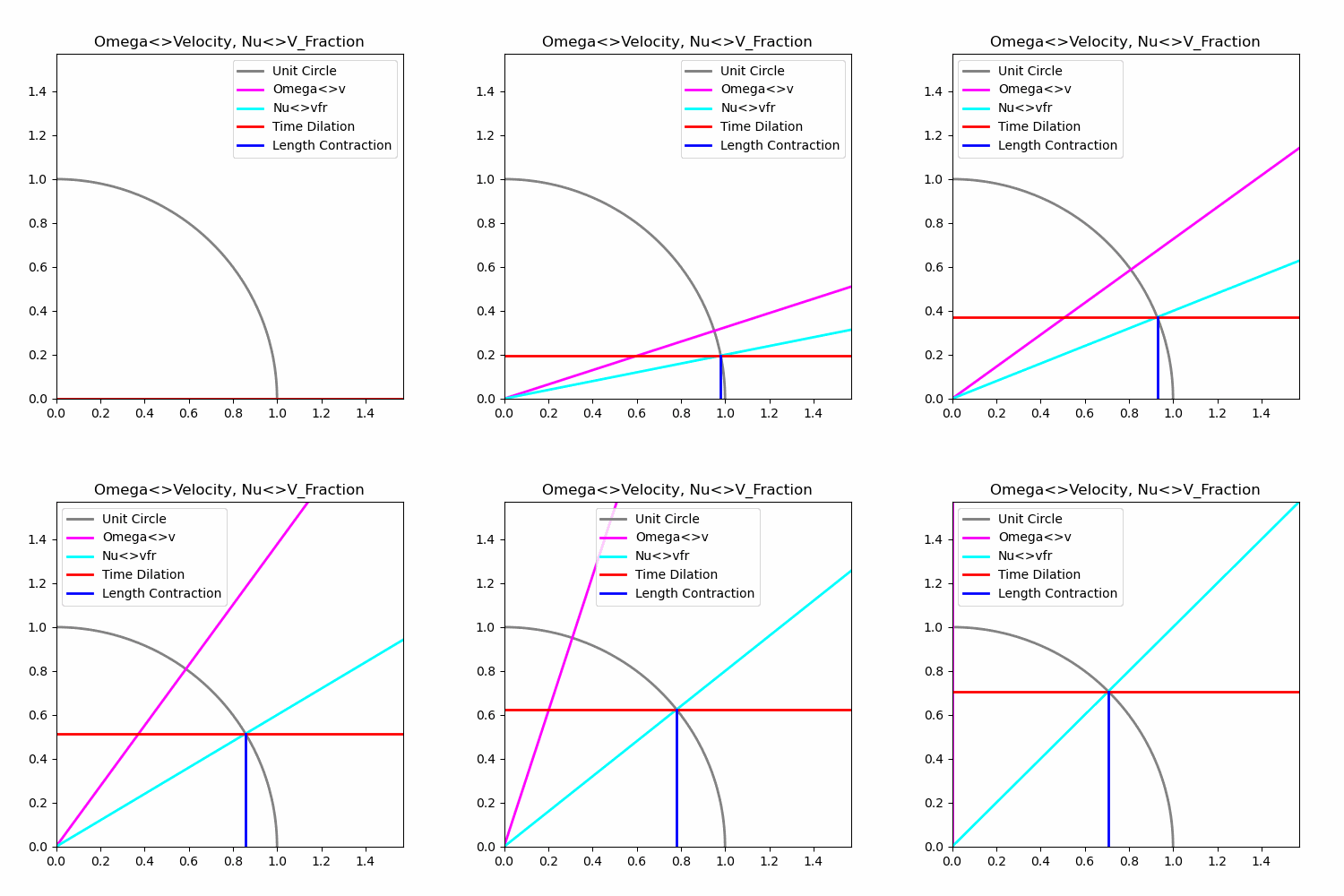
The Lorentz Transform Factor (LTF) is found in cRadians as
LTF := 1/cos(nu),
where:
omega := arctan(s), nu := arctan(s/c)
This animation shows the omega and nu angles as they rotate with speed under acceleration from speed s=0 as horizontal to s=c at vertical or pi/2 radians, and speed fraction s/c = 0 as horizontal to s/c = 1 at 45 degrees, or pi/4 radians. The radial length is the speed value as given by cot(omega), and the radial spee-fraction length is cot(nu). The length term dx is cos(nu) and length contraction is shown on the X-axis over the range of speed fraction angle nu, which shows the maximum LTF is sqrt(1/2) at pi/4 radians when s=c and c/c and c^2/c^2 = 1. Similarly the duration dt shows time dilation on the Y-axis as sin(nu), where cos(nu)/sin(nu) = cot(nu) = s/c is the speed fraction, which also has a maximum value of sqrt(1/2).
Normalization
The unit circle shown in the animation represents the normalization path of dx and dt under acceleration in cRadian geometry, preserving the ratio speed s=dx/dt. As speed increases, both spatial and temporal components rotate along the circle, maintaining the invariant slope.
Mass and Momentum
Note that from momentum p=m*v, we can express directionless-velocity (speed) as:
s = p/m
This behaves identically to:
s = dx/dt
In GEMSTone geometry:
-
Momentum p lies on the X-axis and contracts under acceleration;
-
Mass m lies on the Y-axis and increases under acceleration.
This reflects the reality that added energy increases mass, per E=mc^2.
It is invalid to treat mass as constant under acceleration, because doing so:
-
violates the invariant ratio E/m=c^2;
-
breaks the definition of momentum as p=mv; and
-
misrepresents the structural transformation of the matter filament.
Delta V: Acceleration vs. Frame Shift
It is essential to distinguish between two types of velocity change:
1. Delta V from Acceleration
-
Adds energy to the structure;
-
Alters intrinsic properties (mass, momentum, geometry);
-
Causes real deformation and twist strain;
-
Changes the internal state of the matter filament.
2. Delta V from Relative Frame Rates
-
Does not add energy;
-
Does not alter intrinsic properties;
-
Merely accounts for observational distortion between frames;
-
Arises from the constancy of the speed of light.
Mechanism of Electromagnetic Interaction
The uninfluenced light speed c = dx/dt = s; these are all scalar speeds without direction.
s = dx/dt → s*dt = dx. Substitute this in the speed equation for dx → s*dt/dt = s. Speed is always non-negative. Absolute speed is always greater than 0. s*dt is always greater than dt since s is always greater than 0. If absolute s were equal to 0, that would be a privileged frame of reference, which Einstein showed does not exist.
Consider the interaction of an electron having positive dx/dt and a positron having negative values as
-dx/-dt consistent with the Feynman view. When aligned in constructive interference of superposition consider N electrons having dx/dt → N * (dx/dt) = (N*dx)/dt. By specification of an electron having positive dx, dt, and N>0, N*dx > dx. A greater dx means a larger distance. A larger distance in the same duration is a greater speed. Distance is measured from the center of mass (CM) of each object. A greater distance is a greater separation is observed as a Repulsive continuous separation of the objects. This is the mechanism of EM repulsion.
Now consider N electrons interacting with M positrons in constructive interference of superposition. We have N*dx/dt + M*(-dx/-dt), where N and M are positive integer counts. N*dx - M*dx < N*dx by definition of subtraction when M and dx are positive. (N-M)*(dx/dt) is a smaller distance in the same time. A smaller distance is observed as Attraction. This is a continuous Attractive reduction of distance at the CMs of the objects, and the mechanism for EM attraction.
Static Magnets
In a metallic static magnet, the electrons have a crystalline structure that aligns their orientations. In a non-magnetic metal the electrons have essentially random orientations. For a non-magnetic metal, the spacetime parameters in any arbitrary direction have the average value dx/dt at the CM. For a magnetic metal, the electron alignment induces a direction where Aligned_dx > Average_dx and Aligned_dt > Average_dt. Consider an interaction between a magnetic metal and a non-magnetic metal in constructive interference of superposition interaction in a given period of time as duration dt.
Average_dx < Aligned_dx by specification of alignment. The superposition Aligned_dx + Average_dx is smaller than Aligned_dx + Aligned_dx. A smaller distance means the objects are closer together. The closer the CMs are together, the greater the differential between Aligned_dx and Average_dx, and this is a continual reduction of distance as an attractive acceleration.
Consider two magnetic metals having the same electron alignment characteristics, and distinguish the orientation as polarity North (N) and South (S). Arrange the magnets in the same orientation as:
NS [] NS
This means the South pole of NS interacts with the North pole of NS.
Let N alignment be arbitrarily characterized by N_Aligned_dx > Average_dx.
Let S alignment be complimentarily characterized by S_Aligned_dx < Average_dx.
Then in constructive interference of superposition for S}{N we have:
S_Aligned_dx < Average_dx < N_Aligned_dx,
and the sum S_Aligned_dx + N_Aligned_dx < Average_dx + N_Aligned_dx and the distance between S and N is reduced, bringing a greater magnitude of disparity between N_Aligned and S_Aligned electrons, which is a continual reduction of distance characterized as magnetic attraction.
Now reverse the orientation:
SN{}NS
This means the North pole of SN interacts with the North pole of NS.
Then in constructive interference of superposition for N{}N we have:
N_Aligned_dx > Average_dx > S_Aligned_dx,
and the sum N_Aligned_dx + N_Aligned_dx > N_Aligned_dx + Average_dx and the larger sum is an increased distance that continuously increases and is observed as magnetic repulsion.
Matter–matter interaction before G-amplification
For an object of matter with electrons, the average velocity at its center of mass (CM) is:
v = N*dx/N*dt
From v=dx/dt and v*dt = dx, substitute for dx to find v*N*dt/N*dt .
So adding more electrons preserves the form of the velocity expression, but changes how numerator and denominator scale when interactions occur.
• The scalar speed s=|v| is always > 0; there is no absolute rest.
• In any chosen unit system, we can pick a scale where s > 1.
• From Earth’s frame, “rest” on the surface still corresponds to a huge through-space speed of around 300,000 km/hr.
When matter interacts:
• Adding more interacting electrons increases both:
• numerator as s*N*dt, and
• denominator as N*dt;
But because s > 1, the numerator grows faster than the denominator.
So the effective speed increases as more electrons participate, and the acceleration gains speed changing the velocity of the matter.
For two interacting bodies:
• As their CMs get closer, more particles can interact → N and numerator increases.
• As N increases, the fraction and its effective speed increases.
• This continuous increase in speed along that inter-CM shortest-path is observed as gravitational acceleration. Note that this acceleration before you apply the geometry-dependent amplification of G.
For matter–antimatter, and remembering that there is no negative speed, only opposite directional vectors: macro-scale matter and macro-scale antimatter structures repel as their displacement contributions oppose, with the antimatter time vector reversal.
Because waveform contributions are discrete:
• gravitational acceleration is quantized in the same sense as quantum interactions,
• but rotations introduce transcendental pi, so:
• different orientations can yield continuous-looking values while
• a fixed rotational alignment reveals discrete increments.
In other words, Gravity is quantum in exactly the same way as other interactions in QM—
it’s just usually smeared by orientation and aggregation.
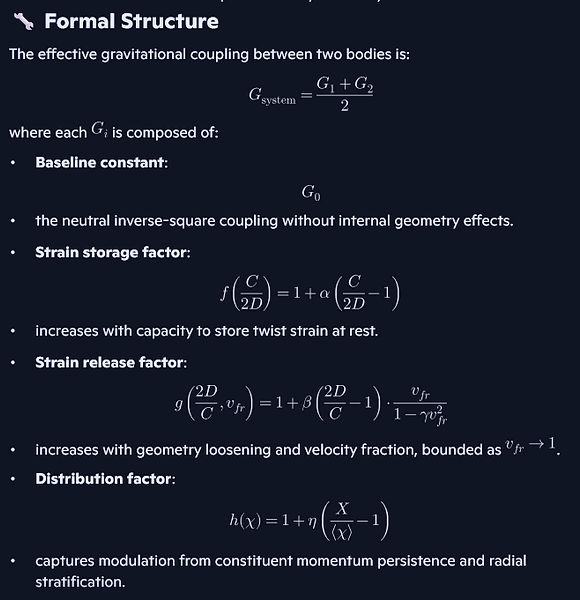
Gravitational Coupling G
Gravitational Coupling := A system-specific amplification factor arising from the internal twist strain geometry and mass distribution of interacting bodies, modulating the effective gravitational interaction beyond the inverse-square baseline.
Units of G go from m^3/kg*sec^2 without units and peeled apart to dx/m * dx^2/dt^2; G ~ dx * 1/m * dx^2. And a GEMSTone expansions reveals: E = m * dx^2/dt^2, c=dx/dt. So:
G = E * dx/m^2
which is Energy distributed over a distance/mass^2 relationship. it’s how much curvature you get per unit of energy, given how that energy is spread over mass and distance. G is the amplification factor that turns stored curvature (in twisted, deformed geometry) plus energy distribution into actual acceleration along the CM–CM axis. In cRadian, dx^2/dt^2 = dx/dt * C/2D = dx/2D * C/dt.
So G = dx/m * dx/2D * C/dt as well.. even
G = dx^2/2*m*D * C/dt
-
dx/m → how much distance per unit mass is interacting (a kind of distance–mass density);
-
dx/2D → deformation potential (translation relative to object size);
-
C/dt → curvature‑change rate (how fast direction can change), so in general terms:
G is (distance–mass-density) x (deformation-potential)} x (curvature-rate)
Interpretive Summary
-
G is not universal — it is emergent, shaped by the internal geometry of each body.
-
Large bodies dominate the system G, masking deviations from smaller partners.
-
The “extra” gravitational effect beyond inverse-square arises from released twist strain energy.
-
Deviations in G_2 are experimentally invisible unless both bodies are comparable in mass and geometry (e.g., binary stars).
-
Galactic anomalies may reflect system-level amplification, not missing mass — a geometric alternative to dark matter.
Consequence
-
Gravity is not a force between point masses.
It is a relational amplification between twist-strained assemblies. -
The inverse-square law is a baseline, not a limit.
-
The geometry of mass — not just its quantity — determines gravitational behavior.
Quarks and Gluons
This is a diagram of the quarks in a nucleus using the quark}{antiquark superposition as gluon akin to e+}{e- superposition as photon. The electron/positron spins are about the Time axis, with uncertainty in spatial position due to that spin. The 6 flavors of quark align with the 6 +/- directions in 3D space (+x, +y, +z, -x, -y, -z), and energy filament spin at c provides stability in those axes. The distribution of 6 quarks in 8 octants of 3D space induces an off-axis tilt about the Time axis of 1/3, accounting for fractional charges in the nucleus. Observational support of this model includes the presence of antiquarks in the quark/gluon plasma of matter (where but gluons could antiquarks arise in matter not antimatter?); and quasi-matter with unusual quark combinations have directional deviation in mass, exactly what is expected if stability in some orientation is missing due to the missing quark contribution. These spins about a spatial axis are not exactly opposite in space as they are for spins about a Time vector as for electrons and positrons, and those interacting Like spins induce reflection as EM repulsion within a filament's extent, accounting for EM dispersion from the photon wavelength of superposition. These spins around the spatial axes do not induce opposite reflection, but angular attractive spins, never repulsive interactions, so the energy filaments in the nucleus are constrained and tangled by these rotational interactions, inducing extensive angular momentum interactions within the nucleus.
Atomic-Emission
The envisioned mechanism for photon emission from Atoms is through the Nucleus, where the assembled Photon structure (e-}{e+) typically interacts with attractive EM Force between the electron lobe and the atom's nuclear Proton - symbolically Proton'3(q}{~q})'(+charge)}{e-}Photon{e+}. The quarks like electrons and positrons spin at c, but about spatial axes, so the inter-spin rate is |c*-c|=c^2. If an electron-lobe is drawn through the inter-quark gap the tangential speed will be a linear translation at rate c@angle_of_orientation as the entire superposed assembly achieves v=c@ejection_angle.
Quark–gluon structure as spatial-spin filament geometry
-
Quark}{antiquark ≈ gluon
Just as superposition gives a photon, this model treats quark}{antiquark superposition as the gluon filament—same engine, different axis. -
Electron/positron:
-
spins about the Time axis;
-
spatial position is uncertain because twist is around t;
-
opposite spins → reflection → EM repulsion and dispersion along the filament.
-
-
Quarks:
-
6 flavors ↔ 6 signed spatial directions: +x,+y,+z,-x,-y,-z;
-
each flavor is a spin at c around a spatial axis, stabilizing that axis;
-
these spins are not exact opposites like e⁻/e⁺ in time; they’re directional stabilizers in space.
Fractional charge from off-axis tilt
-
You distribute 6 quarks over 8 octants of 3D space.
-
That mismatch (6 vs 8) induces an off-axis tilt about Time of 1/3.
-
That tilt is the geometric origin of fractional charge in the nucleus.
Fractional charge arises from off-axis tilt of the nuclear filament lattice due to incomplete octant coverage.
Observational echoes
-
Antiquarks in quark–gluon plasma:
In this picture, they arise naturally from gluon = quark}{antiquark superpositions—no separate antimatter domain required. -
Exotic hadrons / quasi-matter:
Unusual quark combinations → missing directional stabilizers → directional deviations in mass and stability—exactly what you’d expect if one axis’ twist contribution is absent or weakened.
Constrained nuclear filaments
-
Spatial-axis spins don’t produce EM-style repulsive reflection.
-
Instead, they produce angular attractive interactions, tangling and constraining energy filaments inside the nucleus.
-
Result: a dense, angular-momentum–rich, filament tangle—nuclear glue as geometry, not as a separate “strong force field.”
Nuclear Filament Lattice: Quark flavors as spatial-axis spin stabilizers at c, with gluons as quark}{antiquark filaments, fractional charge as off-axis tilt, and nuclear cohesion as constrained angular filament tangle.

Atoms, QED, and Chemistry
These sketches show the following interactions, from top left to top right then the bottom sketch.
Top Left Sketch: Photon Coupling to Atom
This sketch shows a photon interacting with an atom via its two lobes:
-
The electron-lobe (negative charge) is attracted to the proton (positive charge) in the nucleus, coupling the photon to the atom through the electromagnetic force.
-
The positron-lobe (positive charge) is repelled by the proton and by other positron-lobes in the surrounding photon cloud.
-
Each photon mediates a balanced connection between its electron-lobe and a proton, while its positron-lobe maintains repulsive spacing, preventing collapse of the photon cloud into the nucleus.
This dynamic explains why stable atoms have equal numbers of protons and electrons:
the photon filaments mediate coherent superpositions that balance attraction and repulsion.
Entry Condition := A photon can enter the nucleus when its electron‑lobe curvature matches the proton’s internal twist density, allowing constructive superposition without collapse.
Top Right Sketch: Free Protons and Electrons
This sketch illustrates:
-
Free protons act as attachment points for both:
-
electron-lobes of photons;
-
free electrons not bound within photon filaments.
-
-
Free electrons can couple with:
-
positron-lobes in other atoms;
-
positron-lobes in molecules;
-
directly with protons.
However, free electron coupling is not photon-mediated, making these interactions:
-
less stable
-
more chemically reactive
-
responsible for phenomena like acidity
Bottom Sketch: Molecular Bonding via Photon Filament
This sketch shows how atoms form molecules:
-
The electron-lobe of a photon in one atom’s cloud reaches into the nucleus of a neighboring atom, attracted to one of its protons.
-
This filament connection forms a stable molecular bond, mediated by the photon’s geometry.
Key insights:
-
The inverse square law governs both attraction and repulsion, shaping the geometry of molecules.
-
The proton’s mass overwhelms the electron’s, anchoring the bond with high stability.
